The Visual Confidence Gap: eCommerce’s Most Expensive Problem
For high-consideration industries like furniture, home decor, and appliances, the digital showroom has always been a compromise. Customers are asked to make significant financial and emotional investments based on a limited set of images. A clean silo shot shows the product’s details. A few staged lifestyle photos suggest a potential aesthetic. But do they answer the critical questions that drive a purchase?
- *”Will this navy-blue armchair clash with my beige walls and hardwood floors?”*
- *”Does this minimalist coffee table look substantial enough next to my oversized sectional?”*
- *”I love this lamp, but my living room has a coastal vibe. Will it fit in?”*
Traditional photography, no matter how professionally executed, cannot answer these highly personal, context-specific questions at scale. The result is a massive friction point in the buying process. Industry data consistently shows that a significant percentage of online returns—up to 25% in some categories—are attributed to the product not meeting expectations or ‘looking different in person.’ This isn’t just a shipping cost; it’s a logistics nightmare, a drain on customer service resources, and a corrosive force on brand loyalty.
This is the visual confidence gap, and it represents one of the biggest untapped opportunities for growth in modern retail. Closing this gap requires moving beyond static imagery and embracing a more dynamic, personalized, and scalable visual commerce strategy.
The Limitations of the Traditional Visual Workflow
Before we explore the future, it’s crucial to understand why the current model is straining under the weight of consumer expectations. The conventional process for creating product visuals is notoriously rigid, expensive, and slow.
1. Astronomical Production Costs: A single lifestyle photoshoot requires coordinating photographers, stylists, locations, and logistics. Creating just three or four unique scenes for one product can cost thousands of dollars. Scaling this across a catalog of hundreds or thousands of SKUs is financially prohibitive for all but the largest global brands.
2. Operational Inefficiency: For retailers and e-tailers sourcing products from multiple vendors, achieving eCommerce catalog standardization is a constant struggle. Supplier-provided imagery varies wildly in quality, lighting, and style. The manual effort required to standardize these assets creates a significant operational bottleneck, slowing down time-to-market for new products.
3. Inflexibility and Creative Stagnation: Once a photoshoot is complete, those assets are final. If a new design trend emerges mid-season—like the rise of ‘dopamine decor’ or ‘Japandi’ interiors—brands cannot pivot their visual marketing to align with it. They are locked into the scenes they shot months ago, unable to tap into real-time consumer interests.
This rigid system forces businesses into a trade-off between visual richness and operational scalability.
The Old Way vs. The New Way: A Head-to-Head Comparison
To fully appreciate the paradigm shift, a direct comparison is illuminating. For any data-driven eCommerce leader, the differences in efficiency and capability are stark.
FactorTraditional PhotoshootsAI-Powered Visualization Cost per SceneHigh (Thousands per lifestyle shot)Extremely Low (Pennies on the dollar)Speed to MarketSlow (Weeks or months of planning and execution)Fast (Minutes or hours to generate dozens of scenes)ScalabilityLow (Financially and logistically impossible to scale)Infinite (Easily generate visuals for entire catalogs)Creative FlexibilityZero (Locked into assets post-shoot)Limitless (Adapt to trends and A/B test styles instantly)PersonalizationOne-to-Many (Generic scenes for a broad audience)One-to-One (Cater to niche aesthetics and individual tastes)
This isn’t just an incremental improvement; it’s a fundamental re-architecting of how visual content is created and deployed in retail.
The AI Inflection Point: From Static Catalogs to Living Visual Ecosystems
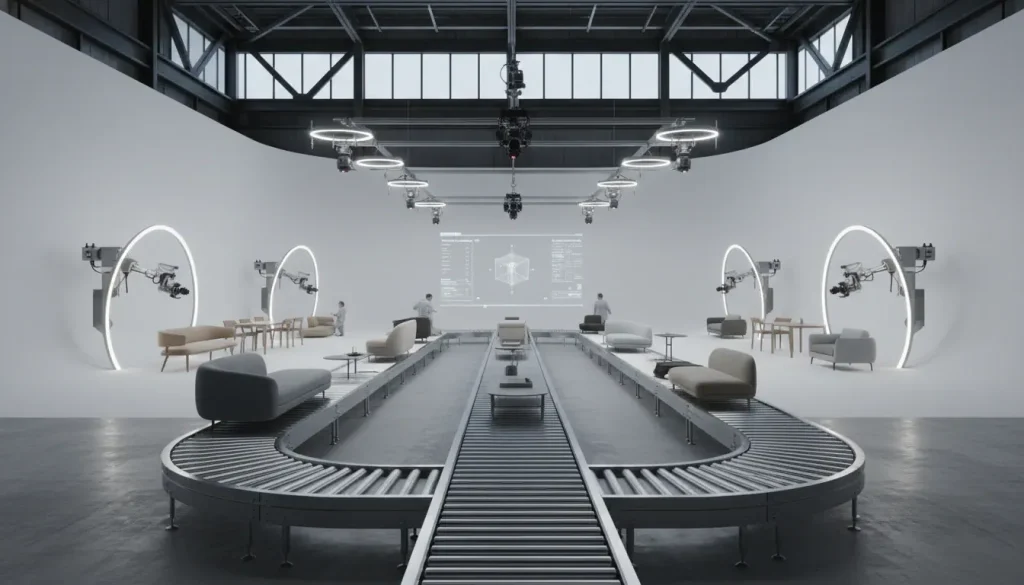
This is the new reality being enabled by sophisticated AI. AI-powered product previews are revolutionizing visual commerce by leveraging generative technology to create automated lifestyle imagery—vast libraries of photorealistic visuals that speak directly to individual customer needs.
Unlike cumbersome legacy technologies that required heavy technical lifts, this new approach is lightweight, fast, and built on the assets you already have: your 2D product photos. Here’s how this AI in eCommerce is changing the game.
Generating Infinite Context at Unprecedented Scale
The most powerful way to increase buyer confidence is to show, not just tell. Imagine a customer looking at a modern oak dining table. With an AI-driven visual platform, they are no longer limited to the two or three lifestyle shots you paid for. From one clean silo image, you can instantly generate dozens of high-fidelity scenes that allow for true visual content for personalization.
This isn’t about creating fake-looking composites. Modern AI can render these scenes with an incredible degree of realism, accounting for light, shadows, and texture. It’s a paradigm shift from a one-to-many to a one-to-one visual conversation.
Achieving True eCommerce Catalog Standardization
For large retailers, the challenge of visual inconsistency can severely damage brand perception. AI-driven strategies offer a powerful solution. By processing supplier images through a centralized platform, retailers can automatically generate a standardized set of visuals for every single product, from perfectly clean silo images to consistent lifestyle galleries. This operational efficiency is transformative, allowing merchandising teams to focus on strategy instead of manual image editing.
The Measurable Impact of an AI-Driven Visual Commerce Strategy
Adopting eCommerce innovation is not just about staying current; it’s about driving tangible business results. Integrating AI into your visual workflow directly impacts the metrics that matter most.
#### Impact #1: Convert More Shoppers by Closing the Confidence Gap
When customers see a product in a context that mirrors their own life, doubt is replaced with certainty. This is a powerful conversion driver. Early adopters implementing AI-generated contextual images are reporting conversion lifts of up to 15% on product pages featuring this enhanced content. By proactively answering visual questions, you remove friction and help close the confidence gap before the ‘buy’ button is ever clicked.
#### Impact #2: Slash Return Rates and Protect Your Bottom Line
Returns are the bane of eCommerce profitability. A study by Invespcro highlights that 22% of returns happen because the item looks different in person. An intelligent visual strategy is the most effective tool to combat this. Brands providing richer, more diverse visual contexts are seeing ‘product not as expected’ returns drop by 5-10% within the first six months. This is how you reduce returns and turn a major cost center into a competitive advantage.
#### Impact #3: Increase AOV with Inspirational, Shoppable Scenes
Inspirational visuals sell a vision, not just a product. When a customer sees a beautifully styled living room scene generated around a sofa, they are also exposed to a complementary rug, lamp, and coffee table. This is a far more effective form of cross-selling than a simple widget. Platforms like Viziq are engineered to help brands build these complete, shoppable looks from your existing product photos, encouraging customers to build a bigger basket and measurably increasing Average Order Value.
Beyond the Product Page: AI Visuals for Marketing Agility
The value of a nearly infinite library of high-quality visuals extends far beyond your product detail pages. It unlocks a new level of speed and relevance for your entire marketing ecosystem.
Imagine being able to:
- Hyper-Personalize Ad Campaigns: Target users interested in ‘Coastal Grandmother’ decor with ads showing your products in light, airy, beach-themed rooms. Simultaneously, target ‘Urban Modern’ enthusiasts with images of the same products in a sleek, industrial loft setting—all without a single photoshoot.
- Refresh Email Marketing Instantly: Tired of using the same hero image for your weekly newsletter? Generate a dozen new, on-brand lifestyle shots in minutes to keep your content fresh, engaging, and seasonally relevant.
- Dominate Social Media Feeds: Create an endless stream of unique, eye-catching visual content for Instagram, Pinterest, and Facebook. A/B test different room styles and aesthetics to see what resonates most with your audience, optimizing engagement in real-time.
This is marketing agility, powered by AI. It transforms your visual content from a static, expensive asset into a dynamic, flexible tool for growth.
Putting AI to Work: A Practical Roadmap for Implementation
Embracing this future of retail doesn’t require a massive tech overhaul. The beauty of this modern approach is its accessibility.
1. Start with What You Have: Gather your best existing product images—even a single, high-quality silo shot is often enough to get started.
2. Define Your Visual Identity: Identify your key customer personas and the aesthetics that resonate with them. This will guide your AI scene generation.
3. Leverage a Purpose-Built Platform: Partner with a specialist in AI-powered product visualization. For large-scale retailers, the operational efficiency of a platform like Viziq becomes a significant competitive advantage, designed to ingest, standardize, and enrich thousands of product images with minimal human intervention.
4. Test, Learn, and Optimize with Precision: Deploy your new AI-generated visuals and monitor the right KPIs to quantify their impact. Go beyond conversions and track:
– Image Gallery Engagement: Are users interacting more with the new, diverse set of images?
– Time on Page: Does a richer visual experience keep shoppers on the page longer?
– Add-to-Cart from Lifestyle Images: Can you attribute basket additions directly to your inspirational scenes?
– Return Rate by Category: Pinpoint which product types benefit most from enhanced visualization.
The Future is Visual, and It’s Here Now
The evolution of eCommerce will be defined by the quality of the customer experience. For too long, the digital shopping experience for home goods has been flat, uninspired, and uncertain. The leap forward will not be driven by clunky gimmicks, but by intelligent, scalable AI that enhances the 2D images that are the bedrock of the internet.
Brands that continue to rely on a ‘good enough’ visual strategy will be outmaneuvered by competitors who can offer a richer, more personalized, and more confident path to purchase. The technology to create a truly dynamic and persuasive visual experience exists today. The only question is whether you will be a leader in this new era or be left struggling to explain why a picture is no longer enough.
If you want to hear more – can see more info on AI Generated Visuals here at Viziq